

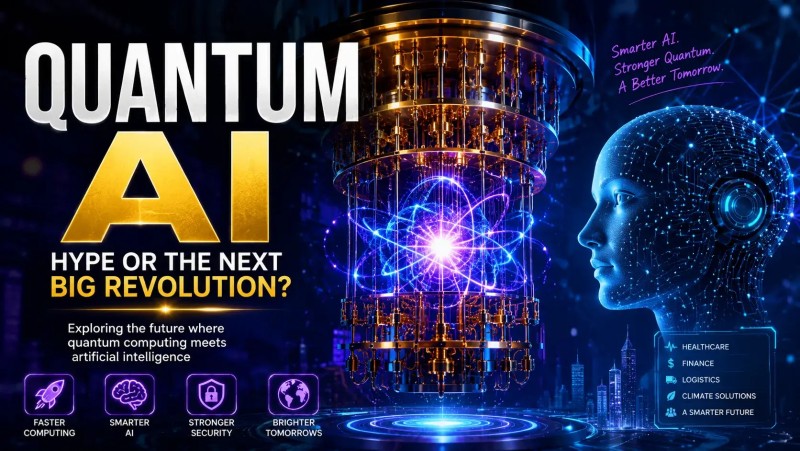
Artificial Intelligence has already changed the way we work, search for information, create content, and even write code. At the same time, another technology has quietly been developing behind the scenes quantum computing. Individually, both are powerful. Together, they could reshape industries in ways we're only beginning to imagine.
This combination is known as Quantum AI, and it's one of the hottest topics in technology today. Some believe it will solve problems that today's fastest supercomputers can't handle. Others argue that it's still more science experiment than real-world solution.
So where does the truth lie? Is Quantum AI genuinely the future, or is it another technology surrounded by unrealistic expectations?
What exactly is Quantum AI?
To understand Quantum AI, you first need to understand what makes quantum computers different.
Every computer you use today—whether it's your smartphone or a powerful data center processes information using bits. A bit can only be a 0 or a 1.
Quantum computers work differently. They use qubits, which can represent multiple possibilities at the same time thanks to the strange rules of quantum mechanics. This allows quantum computers to explore many potential solutions simultaneously instead of checking them one after another.
Now imagine combining that computing power with artificial intelligence.
Instead of replacing AI, quantum computing could help AI learn faster, process enormous datasets more efficiently, and solve optimization problems that would take traditional computers years to complete.
That's the promise of Quantum AI.
Why is everyone suddenly talking about it?
The excitement isn't coming from social media hype alone.
Companies like IBM, Google, Microsoft, Amazon, NVIDIA, and several fast-growing startups are investing billions of dollars into quantum research. Governments across the world are also funding national quantum programs because they believe the technology could become as important as the internet or artificial intelligence itself.
The reason is simple.
Many of the world's hardest problems aren't impossible because we don't understand them they're impossible because today's computers aren't powerful enough to calculate every possibility within a reasonable time.
Quantum AI aims to change that.
Where could Quantum AI make the biggest impact?
Healthcare is one of the most promising areas.
Developing a new medicine can take years because researchers must analyze millions of molecular combinations. Quantum AI could dramatically speed up these simulations, helping scientists discover treatments faster while reducing research costs.
The financial industry is equally interested.
Banks constantly analyze enormous amounts of market data to predict risks, optimize investments, and detect fraud. Faster processing could allow financial institutions to make smarter decisions in real time.
Then there's logistics.
Imagine planning delivery routes for thousands of trucks across hundreds of cities while considering traffic, weather, fuel costs, and customer priorities. Even powerful computers struggle with these calculations.
Quantum AI could evaluate millions of possible routes almost simultaneously, finding solutions that save both time and money.
Climate research is another area where Quantum AI could shine.
Creating accurate climate models requires processing extraordinary amounts of environmental data. More powerful computing could improve weather forecasting, energy optimization, and climate predictions that help governments prepare for future challenges.
If it's so powerful, why aren't we already using it?
This is where reality catches up with the excitement.
Today's quantum computers are incredibly impressive but they're also incredibly fragile.
Even tiny vibrations, temperature changes, or electrical interference can introduce errors into calculations. Scientists spend enormous amounts of time simply trying to keep quantum systems stable long enough to perform useful work.
Another challenge is software.
Most AI systems are designed for classical computers. Building entirely new algorithms that take advantage of quantum hardware is an active area of research, and many of those algorithms still exist only inside research laboratories.
In other words, Quantum AI isn't waiting for one big breakthrough. It's waiting for hundreds of smaller breakthroughs to come together.
So... is Quantum AI just hype?
Not exactly.
Some headlines make it sound as if quantum computers will replace every laptop and server within a few years. That's unrealistic.
We're still in the early days, similar to where artificial intelligence was a decade ago. Researchers know the technology has enormous potential, but turning that potential into practical products takes time.
The hype becomes a problem only when people expect instant results.
The reality is much more exciting.
Every year, quantum hardware improves. Every year, researchers publish better algorithms. Every year, companies move a little closer to practical applications.
Progress may seem slow from the outside, but it's happening.
What happens next?
Most experts believe Quantum AI won't replace traditional AI it will work alongside it.
Classical computers will continue handling everyday tasks, while quantum systems tackle highly specialized problems involving massive datasets, scientific simulations, and complex optimization.
For businesses, that means faster research, smarter decision-making, and entirely new possibilities that simply aren't practical today.
For the rest of us, it means the AI tools we use in the future could become faster, more accurate, and capable of solving problems we currently consider impossible.
Final Thoughts
Quantum AI isn't science fiction anymore, but it isn't an everyday technology either.
Right now, it's a field filled with enormous promise, backed by some of the biggest technology companies and research organizations in the world. The road ahead is challenging, but the progress being made suggests that Quantum AI is far more than just another buzzword.
Will it revolutionize the world tomorrow? Probably not.
Could it become one of the defining technologies of the next decade?
That possibility is becoming harder to ignore with every new breakthrough.