

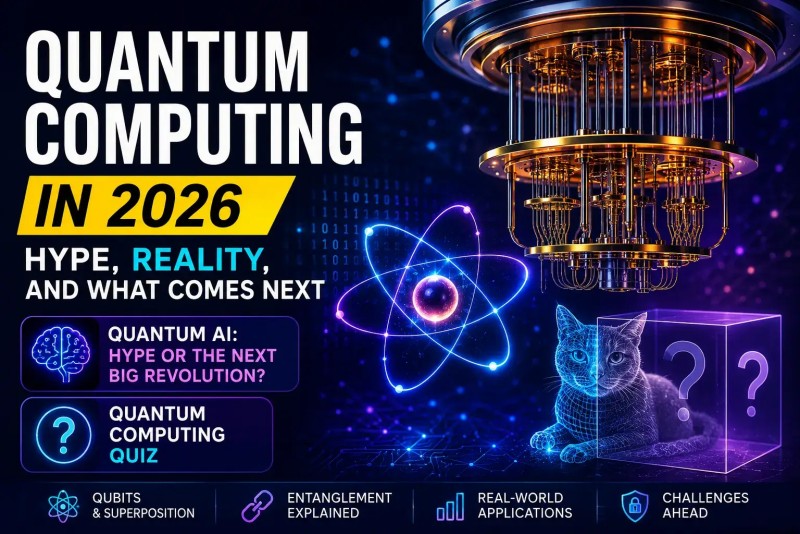
Quantum computing is no longer a science-fiction concept discussed only in research labs. Governments, universities, and major technology companies are investing billions of dollars into quantum research, hoping to unlock computing power that could solve problems impossible for today’s classical computers.
At the same time, the internet is flooded with bold claims about Quantum AI, quantum supremacy, and machines that will supposedly revolutionize everything from healthcare to finance overnight. So where does the truth lie? Is quantum computing overhyped, or are we witnessing the early stages of the next major technological revolution?
In this article, we’ll explore the current state of quantum computing, separate hype from reality, and share two useful resources from our earlier posts that can help you dive deeper into the topic.
What Makes Quantum Computing Different?
Traditional computers store information as bits that are either 0 or 1. Quantum computers use qubits, which can exist in a combination of states thanks to superposition. When multiple qubits become entangled, their states are linked in ways that allow certain calculations to be performed far more efficiently than classical systems.
This doesn’t mean quantum computers are simply “faster” at everything. They are designed for specific types of problems, such as:
- Cryptography and code breaking
- Molecular and materials simulation
- Optimization problems
- Certain machine learning and search algorithms
For everyday tasks like browsing the web, running WordPress, or editing photos, classical computers remain the better choice.
The Current Reality in 2026
Researchers have made impressive progress in increasing qubit counts and reducing error rates. Companies such as IBM, Google, Microsoft, and several startups continue to develop more stable quantum hardware and software ecosystems.
However, the field still faces major challenges:
1. Error Rates
Qubits are extremely sensitive to noise and environmental disturbances. Even tiny vibrations or temperature fluctuations can introduce errors.
2. Scalability
Building a machine with thousands or millions of reliable qubits is enormously difficult.
3. Practical Algorithms
Many theoretically powerful quantum algorithms require far more stable qubits than today’s hardware can provide.
As a result, we are still in what many experts call the NISQ era (Noisy Intermediate-Scale Quantum), where quantum computers are useful for experimentation and research but are not yet replacing classical supercomputers for most real-world workloads.
Why Quantum AI Is Creating So Much Buzz
One of the hottest trends is the idea of combining quantum computing with artificial intelligence. The promise is attractive: quantum systems could potentially accelerate parts of machine learning, optimization, and data analysis.
But it’s important to be cautious. Many marketing claims suggest that simply adding the word “quantum” to an AI product makes it revolutionary, even when no quantum hardware is involved.
We explored this issue in detail in our earlier post:
→ Read: Quantum AI: Hype or the Next Big Revolution?
That article breaks down:
- What Quantum AI actually means
- Which claims are realistic
- Where quantum-enhanced machine learning might provide genuine advantages
- Why investors and startups are so excited about the space
If you’re hearing terms like quantum neural networks or quantum-enhanced AI and want a balanced explanation, that post is a great starting point.
Industries Most Likely to Benefit First
While consumer applications are still years away, several industries could see meaningful benefits earlier than others.
Drug Discovery and Chemistry
Simulating molecular interactions is computationally expensive. Quantum computers may eventually model these interactions more accurately, potentially speeding up the development of new medicines and materials.
Logistics and Optimization
Airlines, shipping companies, and manufacturing firms constantly solve complex optimization problems involving routes, schedules, and resources. Quantum algorithms may offer improvements for some of these tasks.
Finance
Portfolio optimization, risk analysis, and certain types of simulation could benefit from quantum techniques, although practical commercial advantages remain uncertain.
Cybersecurity
Quantum computing poses a long-term threat to current public-key encryption systems, which is why governments are actively developing post-quantum cryptography standards.
Common Myths About Quantum Computing
Myth 1: Quantum Computers Will Replace All Computers
They are likely to become specialized accelerators used alongside classical systems, similar to how GPUs complement CPUs today.
Myth 2: Quantum Supremacy Means Commercial Usefulness
A quantum computer may outperform classical computers on a narrowly defined benchmark without being useful for practical business applications.
Myth 3: Quantum AI Already Powers Most AI Products
The vast majority of AI applications today run on classical hardware, including GPUs and specialized AI accelerators.
Test Your Understanding
If you’d like to check how well you understand the basics of quantum computing, we created a short interactive quiz:
→ Take the quiz: Quantum Computing Quiz
It covers:
- Qubits
- Superposition
- Entanglement
- Quantum gates
- Real-world applications and limitations
The quiz is beginner-friendly and designed for students, developers, and tech enthusiasts who want a quick knowledge check.
Final Thoughts
Quantum computing sits in an unusual position: it is simultaneously one of the most overhyped and one of the most genuinely promising technologies of our time.
The hype comes from exaggerated claims that quantum computers will instantly solve every computational problem and make classical computing obsolete. The promise comes from decades of solid physics research showing that quantum systems can perform certain calculations in fundamentally different ways.