

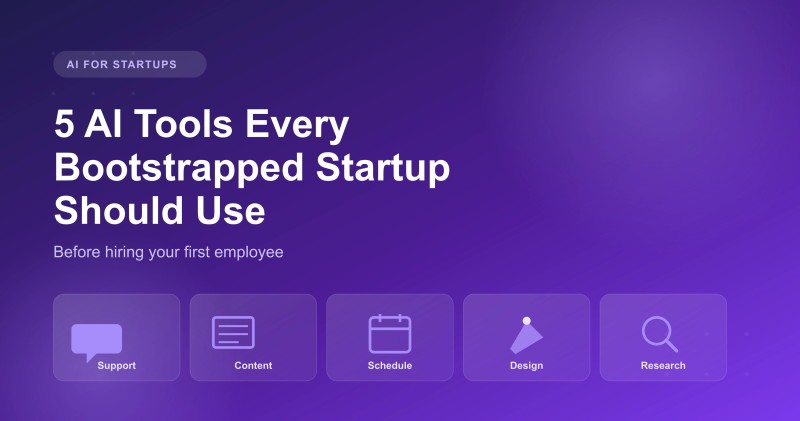
Hiring is expensive. A single early hire can cost a bootstrapped founder $40,000–$80,000 a year before you even know if the role is necessary. Before you write that first offer letter, it's worth asking: can AI handle 70% of this job today?
For a lot of early-stage roles like support, content, basic design, scheduling, and research, the answer is increasingly yes. Here are five categories where AI tools can genuinely replace or delay a hire, backed by real 2026 pricing, not just make one person's job easier.
1. Customer Support: AI Chat Agents
Before you hire a support rep, most early customer questions are repetitive: pricing, refunds, "how do I do X." AI-powered helpdesk tools can now handle a large share of these automatically, escalating only the genuinely complex tickets to you.
Intercom Fin is a strong starting point for early-stage teams because it's priced per resolution ($0.99 each) rather than a flat monthly seat fee, so cost scales directly with your actual support volume instead of committing you to a large fixed bill before you have the ticket volume to justify it.
If you want something even simpler to set up, Tidio runs about $29/month and works well out of the box for ecommerce and service businesses without much configuration.
What to look for in any option:
- Ability to train on your own docs/FAQ, not just generic answers
- Clear escalation rules so it doesn't guess on refunds or account issues
- A dashboard so you can see what it's answering wrong and fix it
This doesn't mean you never need a human. It means you can delay that hire until support volume justifies it, and the person you eventually hire spends their time on judgment calls instead of repeating the same answer fifty times a day.
2. Content and Marketing: AI Writing Assistants
A full-time content marketer is a significant early hire. Before that, a founder (or a part-time freelancer) using AI tools can realistically maintain a blog, social posts, and email newsletters, as long as a human is editing, not just publishing raw output.
The realistic workflow:
- Use AI to draft outlines and first passes
- A founder or freelance editor adds real product knowledge, customer stories, and voice
- Publish consistently rather than perfectly
This is the same principle covered in our guide to best AI tools in 2026 and our breakdown of common ChatGPT mistakes beginners make. AI removes the blank-page problem, not the need for a real editor.
3. Scheduling and Admin: AI Assistants
Calendar coordination, meeting notes, and follow-up emails are classic "death by a thousand cuts" work that used to justify an executive assistant hire.
Important correction if you're researching this yourself: Clockwise, long a default recommendation in this category, was acquired by Salesforce and shut down on March 27, 2026. The current live alternatives are:
- Reclaim.ai: free tier available, paid plans from roughly $8–10/month. Best for auto-protecting focus time by rearranging meetings around it.
- Motion: $19/month, no free tier (7-day trial only). Best if you also want task management, not just calendar defense.
For meeting notes specifically, Otter.ai offers a free tier (300 transcription minutes/month) and paid plans from about $8.33–$16.99/month depending on annual vs. monthly billing, useful for turning calls into searchable notes and action items without a dedicated assistant.
None of this replaces an EA for a founder managing dozens of daily meetings, but for most early-stage founders doing 5–10 meetings a week, it removes enough friction to delay that hire by months.
4. Basic Design: AI Design Tools
You don't need a full-time designer to make a landing page, pitch deck, or social graphics look professional anymore.
Canva Magic Studio (Canva Pro) runs about $13–15/month and bundles AI layout generation, background removal, and brand-consistent resizing once you set up your brand colors and fonts once. A free tier exists for light use, but the AI features are limited on it.
Where this breaks down: truly custom product design, complex UX work, or anything requiring deep user research still needs a real designer. Use AI tools for the 80% of visual assets that are repetitive (social posts, simple slides, basic landing pages), and save actual hiring budget for the 20% that needs real design thinking.
5. Research and Competitive Analysis
Market research, competitor tracking, and summarizing customer feedback used to require an analyst or a lot of a founder's own time.
Perplexity Pro, at $20/month, is built specifically for this: it pulls together competitor information, market data, and citation-backed answers faster than manual searching, which is one of the highest-leverage uses of AI for a founder because it's work that directly informs decisions.
The Honest Limits
AI tools don't replace judgment, relationships, or accountability. They're best at:
- High-volume, repetitive tasks
- First drafts that a human refines
- Synthesizing information faster than a person could alone
They're bad at:
- Anything requiring your specific product judgment
- Building real relationships with early customers
- Catching subtle context a human would notice immediately
The Real Question to Ask Before Hiring
Before your next hire, ask: is this role mostly repetitive tasks I could delegate to an AI tool with light human oversight, or does it require judgment, relationships, and context only a person can bring? If it's the former, a $20–100/month tool might buy you another 6–12 months of runway before that hire becomes necessary. If it's the latter, don't try to automate around it: hire the person.
The goal isn't to avoid hiring forever. It's to hire later, and hire smarter, because you spent your early budget on tools instead of a role AI could have covered.
Frequently Asked Questions
Can AI tools really replace a full-time hire for a startup?
Not entirely, but they can delay a hire for repetitive, high-volume tasks like basic customer support, scheduling, and first-draft content. Roles that require judgment, relationships, or deep product context still need a human.
What is the cheapest way to add AI customer support for a startup?
Usage-b